Solder mask
Solder mask, sometimes also referred to as solder stop mask or solder resist, is a thin layer of polymer that is usually applied to the copper traces of a printed circuit board (PCB). This layer of lacquer serves to [...]

Solder mask, sometimes also referred to as solder stop mask or solder resist, is a thin layer of polymer that is usually applied to the copper traces of a printed circuit board (PCB). This layer of lacquer serves to [...]
Selective soldering has been on the rise in recent years. Sometimes the selective soldering system completely replaces the wave solder machine. Ersa-ECOSELECT-1 More and more we see that 80% or even more of the components used are [...]
Nowadays almost all electronic products are soldered fully automatically. This is possible with soldering machines such as: wave soldering machines, reflow ovens, selective soldering, pin-in-paste soldering, vapor phase soldering, laser soldering, soldering robots, etc. In this article we describe the [...]
If we talk about bare board (or PCB) manufacturing 2 IPC documents are commonly used. The one that is best known throughout the electronics industry is the IPC-A-600. The A in the designation tells us that these are Acceptance Criteria, [...]
One of the Gull-Wing (*) style components are called QFP components. It is a component from the Gull-Wing family of SMD components, other Gull-Wing family styles are SOT, SOD and SOIC components. The specific property of the QFP or Quad [...]
Printed Circuit Boards (PCBs) / PWBs (Printed Wiring Boards) are well known in electronics. The first printed circuit board, invented by Paul Eisler, dates back to 1936. At that time, the conductor tracks were drawn by hand and that was [...]
BTC-components are the “new generation” ICs that take up considerably less space than their “older” predecessors such as QFPs, SOICs, etc. BTCs (as the name suggests) do not have leads (legs) on the side of the component but metallized surfaces [...]
When handling ESD-sensitive products, grounding is the most important thing! This is possible using a wrist strap, ESD shoes, ESD safety clothing, etc. and this is common in the EPA (ESD Protected Area). What about ESD-safe gloves, are they [...]
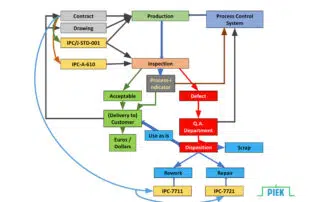
A focus on the IPC-A-610 and IPC J-STD-001 Why this article? The IPC-A-610 and the IPC J-STD-001 are complementary standards, but each has its own purpose. However, it is not always clear to everyone what the specific uses of both [...]
Every advantage has its disadvantage In the new/latest revisions of the IPC-WHMA-620D Requirements and Acceptance for Cable and Wire Harness Assemblies and IPC-A-610H Acceptability of Electronic Assemblies the term TARGET and the pictures to this have disappeared. Advantage: The main [...]